
Adjustable Steel Stumps: How They Solve Foundation Movement on Sloping and Reactive Soil Sites
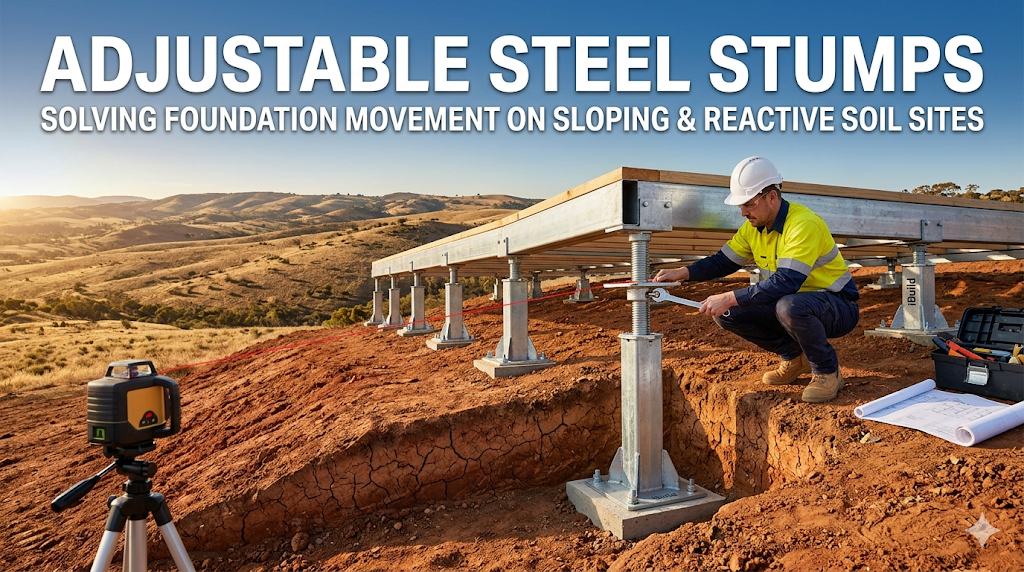
Foundation movement is a common issue in Australian homes, particularly on sloping blocks and reactive soil sites. Changes in soil moisture, ground settlement, and uneven terrain can cause parts of a house to shift at different rates, leading to sloping floors, cracking walls, and long-term structural stress.
On sites where movement is expected rather than avoidable, adjustable steel stumps are increasingly used as a practical foundation solution. Their ability to be fine-tuned during construction and adjusted later allows builders to manage movement rather than fight against it.
What Causes Foundation Movement on Sloping and Reactive Soil Sites?
Reactive Clay Soils
Large areas of Australia are built on reactive clay soils, which expand when wet and contract when dry. This constant cycle of movement can place uneven pressure on house foundations, particularly during seasonal weather changes.
Sloping and Uneven Terrain
Homes built on sloping sites are more likely to experience differential settlement, where one side of the structure moves more than the other. Without a system that allows precise levelling, this can quickly result in uneven floors and structural misalignment.
Moisture Variation and Drainage Conditions
Rainfall patterns, surface runoff, and drainage issues can alter soil moisture levels around a home. Over time, these changes can cause gradual foundation movement, even if the initial build was level.
Why Foundation Movement Is Difficult to Manage With Fixed Stumps
Fixed Heights Leave Little Room for Correction
Traditional fixed stumps are installed to a set height. If the ground settles unevenly after construction, correcting the issue often requires jacking, packing, or restumping, all of which are disruptive and costly.
Movement Transfers Stress to the Building Structure
When foundation movement cannot be corrected easily, stress is transferred into the home itself. This often shows up as cracked plaster, sticking doors, and uneven flooring.
How Adjustable Steel Stumps Help Manage Foundation Movement
Precise Levelling During Initial Construction
Adjustable steel stumps allow builders to achieve accurate height alignment during installation, which is especially important on sloping or irregular sites. This precision helps ensure the home starts level, reducing early-stage settlement issues.
Ability to Re-Level After Ground Settlement
One of the key advantages of adjustable systems is the ability to correct movement over time. If a section of the home settles due to soil movement, individual stumps can be adjusted without major structural work.
This makes adjustable steel stumps particularly effective on reactive soil sites, where some degree of movement is expected throughout the life of the home.
Targeted Adjustment Where Movement Occurs
Instead of lifting or correcting the entire structure, adjustable systems allow specific areas to be addressed independently. This targeted approach reduces disruption and limits unnecessary stress on unaffected parts of the home.
Why Steel Is Used for Adjustable Stump Systems
Steel is commonly used for adjustable stump systems because it offers high load capacity, dimensional stability, and resistance to common environmental issues such as rot and termite damage.
When combined with adjustability, steel provides a stable foundation system that can respond to movement without compromising structural integrity, an important consideration on sloping and reactive sites.
When Are Adjustable Steel Stumps Most Useful?
Adjustable steel stumps are often used for homes built on:
- sloping or uneven blocks
- reactive clay soils
- sites with known settlement risk
- areas with seasonal moisture variation
They are also commonly specified where long-term maintenance access and future re-levelling are important considerations.
Understanding the Long-Term Role of Adjustability
Foundation movement does not always happen immediately. In many cases, changes occur gradually over years as soil conditions shift. Having a system that allows controlled adjustment helps homeowners and builders manage these changes without major intervention.
The broader performance and lifecycle benefits of adjustable systems, including maintenance, cost considerations, and suitability for renovations or modular builds, are explored in more detail in related articles.
Managing Foundation Movement on Challenging Sites
Foundation movement on sloping and reactive soil sites is a reality of Australian construction. Rather than relying on rigid systems that are difficult to correct, many builders now use adjustable steel stumps to manage movement in a controlled and practical way.
By allowing precise levelling during construction and targeted adjustment over time, adjustable systems provide a flexible foundation approach that supports long-term structural stability, even on challenging sites.
Learn More About Adjustable Steel Stump Systems
Understanding how adjustable systems work can help homeowners and builders make better foundation decisions. View iBuild’s Adjustable Steel Stumps to see how engineered adjustability supports long-term site performance.