Yes. All iBuild kit homes and granny flats are engineered and designed to meet Class 1a requirements under the National Construction Code (NCC). When assembled in accordance with the certified plans, you as an owner-builder, or your appointed licensed builder, can obtain the necessary building approvals and achieve full compliance for residential use. Class 1a under the NCC refers to low-rise residential buildings, including primary dwellings and secondary dwellings such as granny flats.
Trust us – you are in safe hands.
https://i-build.com.au/ibuild-kit-homes-australian-made/
As each local council has its own regulations – and your site may also have specific planning overlays, zoning requirements, easements, covenants or other local restrictions – we encourage our clients to print out the floor plan of the design you’d like to build and consult your local council early in the process, ideally through a pre-lodgement meeting, to confirm whether the proposed design is suitable for your site.
For clients seeking extra assistance, we offer an optional approval service to help manage both the planning and building approval process [Approval service, Planning and Building approval link here]. This can save time and reduce stress – especially for first-time owner-builders, those who are time-poor, or anyone unfamiliar with local council requirements.
Linking page –
Whether you need to adjust room sizes, flip the floor plan, add a verandah, or make changes for bushfire or cyclone compliance, we can work with you to tailor a design that meets your needs. Our team will guide you through the process and provide updated plans for approval and construction.
Linking page –
Main page – https://i-build.com.au/ibuild-home-customisation/
How Much to Customise A Design ? link here
Kit Home Customisation link here
https://i-build.com.au/knowledgebase/swap-existing-plans-for-ibuild-design/
iBuild provides a complimentary house energy efficiency report for every client who signs a supply contract (referred to as a BASIX certificate in New South Wales).
Energy ratings are influenced by site-specific factors, such as the orientation of your home to the sun and the local climate zone. We work closely with you to ensure your house design meets the required energy efficiency standards.
Main Linking page – https://i-build.com.au/knowledgebase/house-energy-rating/
Yes, iBuild kit homes can be built on either a concrete slab or a raised foundation, depending on your site conditions and preferences.
The right foundation type depends on multiple factors, including soil type (identified through a soil test), site slope, drainage, flood risk, wind rating, structural load requirements, and cost considerations.
Please consult a qualified civil engineer for advice on the most suitable foundation system for your site.
On flat sites with stable soil, a slab-on-ground is generally the simpler option. However, for sloping sites or areas with reactive or unstable soil, a raised foundation using stumps or piers is often more practical and cost-effective.
To learn more, please see:
Raised vs Slab Foundation Homes
Slab vs Raised Floor for Sloping Blocks
Soil Types & Site Classes
Yes, iBuild offers both timber wall frames and trusses and light gauge steel wall frames and trusses for your kit home.
Timber wall frames and trusses are a classic and cost-effective choice, often preferred by builders and carpenters for their ease of handling and traditional appearance. Timber is easy to work with on-site, but typically requires treatment or ongoing maintenance to protect against termites, moisture and fire.
Steel wall frames and trusses, made from light gauge, cold-formed steel, are surprisingly lightweight, yet strong, straight and highly durable. They are termite-proof and non-combustible, making them ideal for harsh climates and bushfire-prone areas.
Whether you choose timber or steel, iBuild kit homes are designed and engineered in accordance with the National Construction Code and relevant Australian Standards. We’ll work with you to help choose the option that best suits your site, climate and home design.
iBuild offers upgrade options to meet cyclone rating requirements, in accordance with the National Construction Code and relevant Australian Standards, for homes built in designated cyclonic wind regions across Australia.
Flatpack is an industry term used in design or materials-handling to describe how a structure can be packaged to make it easier to store and transport to reduce costs. The purchaser of a flat-pack kit home may choose to erect it yourself (owner-built), or employ a builder to do so, directly or through iBuild.
We deliver Australia wide. In fact, our products are available for worldwide delivery.
Depending on the seasonality in demand and capacity, it normally takes approximately 8~12 weeks to arrive.
iBuild offers nationwide delivery across Australia, covering metropolitan, regional and rural or remote locations.
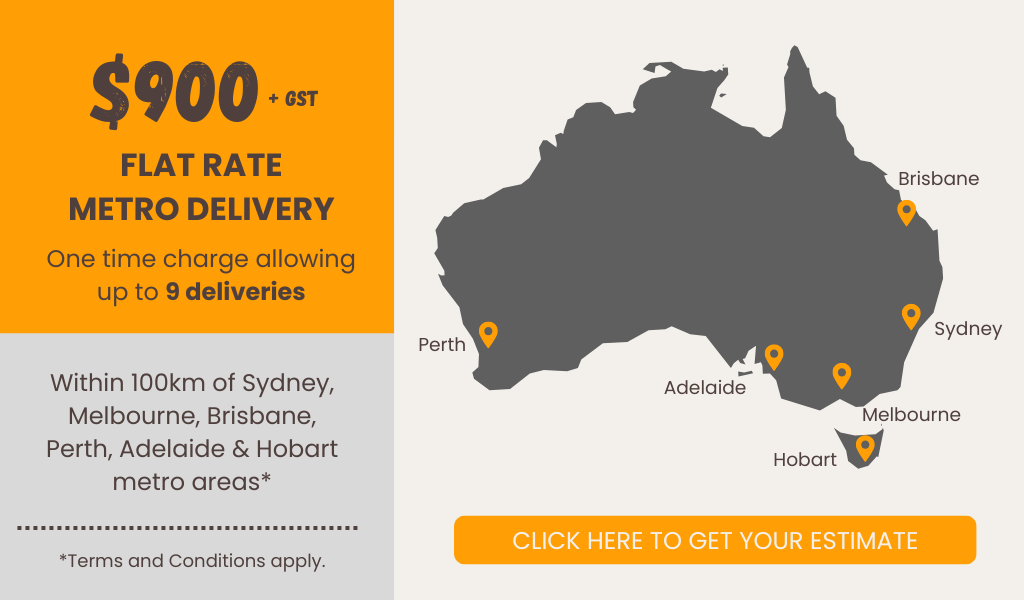
Our delivery system is cost-effective – we dispatch from your nearest capital city, including Sydney, Melbourne, Brisbane, Perth, Adelaide and Hobart. We charge a single fixed delivery fee of $750 + GST per 100 km (land freight only) – whether your kit is delivered in one truckload or up to nine separate deliveries. This one-time charge provides flexibility while keeping costs predictable for locations accessible by road.
Links – https://i-build.com.au/delivery-zones-rates/
Kit homes are delivered to your site on a truck which can be fitted with cranes for easy off-loading.
The kit arrives on site in flat pack form. Structure components such as sub-floor, wall frames and roof trusses are prefabricated to each home design. Clients erect the house in accordance with instruction provided. Internal lining, insulation, external cladding are installed onsite. Client’s electrician can run the wiring along pre-punched holes within the wall studs. Same as plumbing lines.
We deliver Australia wide.
Yes, iBuild kit homes include structural engineering reports for all materials we supply above the foundation level. These reports, prepared by qualified engineers, ensure that key structural components such as wall frames, trusses, and roof framing comply with Australian building standards and codes. Additionally, we offer optional engineering design and certification for raised foundations, tailored to meet the specific needs of your site.
iBuild kit homes can be designed to meet Bushfire Attack Level (BAL) requirements as set out in the National Construction Code (NCC) and relevant Australian Standards, such as AS 3959 – Construction of Buildings in Bushfire-Prone Areas.
If your site is located in a bushfire-prone area, we can offer upgrade options to help comply with the appropriate BAL rating requirements – whether it’s BAL–12.5, 19, 29, 40 or even BAL–FZ (Flame Zone). We’ll work with you to tailor the design and materials to ensure your home is not only compliant but also safer and more resilient in bushfire conditions.
To learn more about Bushfire Attack Level (BAL) Ratings, please click here

iBuild kit homes standard inclusion covers N3 wind rating. For an extra fee, we can offer our customers upgrade options of up to C4.
You can obtain an owner builder permit and save money by constructing the house in accordance with instructions provided. Another option under owner builder is managing the construction process of each trade. Or if you don’t have the time or experience, you can employ a licensed builder to construct your home for you.
Lock up stage means the house is constructed externally, for example the floor system, frames, walls, roof, windows and doors are completed.
iBuild kit homes can be built either on a slab or an elevated floor system.
Once satisfied with your house plan you will enter into a contract in which you pay 10% deposit for the release of plans, and energy certification for council submission. You would pay 10% of contract price at time of ordering the Engineering Design for Wall Frame and Trusses. You then pay 40% of the contract value after obtaining planning permit. The balance of the contract is paid after obtaining building permit so that we can commence procurement and manufacturing.
No, due to our environmental and sustainability policy, we cannot post information material to you. However, our electronic brochures are available on our website for your browsing and download. Please refer to https://i-build.com.au/brochures/
An average-size iBuild home, like the Avila, takes approximately 2-3 months to assemble. This period is dependent on the size of the kit home, weather conditions and the carpenters or tradesmen involved in the project.
Raised floors are on average cheaper. A concrete slab requires multiple different trades to implement, whereas an elevated floor can be accomplished by any owner builder. The cost is dependent on a range of factors; like the tradesmen completing the task and how much labour input you as the owner would like to contribute. Click here to learn more about raised floors vs concrete slabs
The set term is up to 7 years. Click here to get in touch with an iBuild Representative about Handy Pay today.
A rough rule of thumb is that the assembly will be equivalent to the cost of your kit home. Please note it can vary greatly depending on who the builder is and the extent of your input.
Trust us – you are in safe hands.