
Same home, different stars: the 7 star energy rating explained
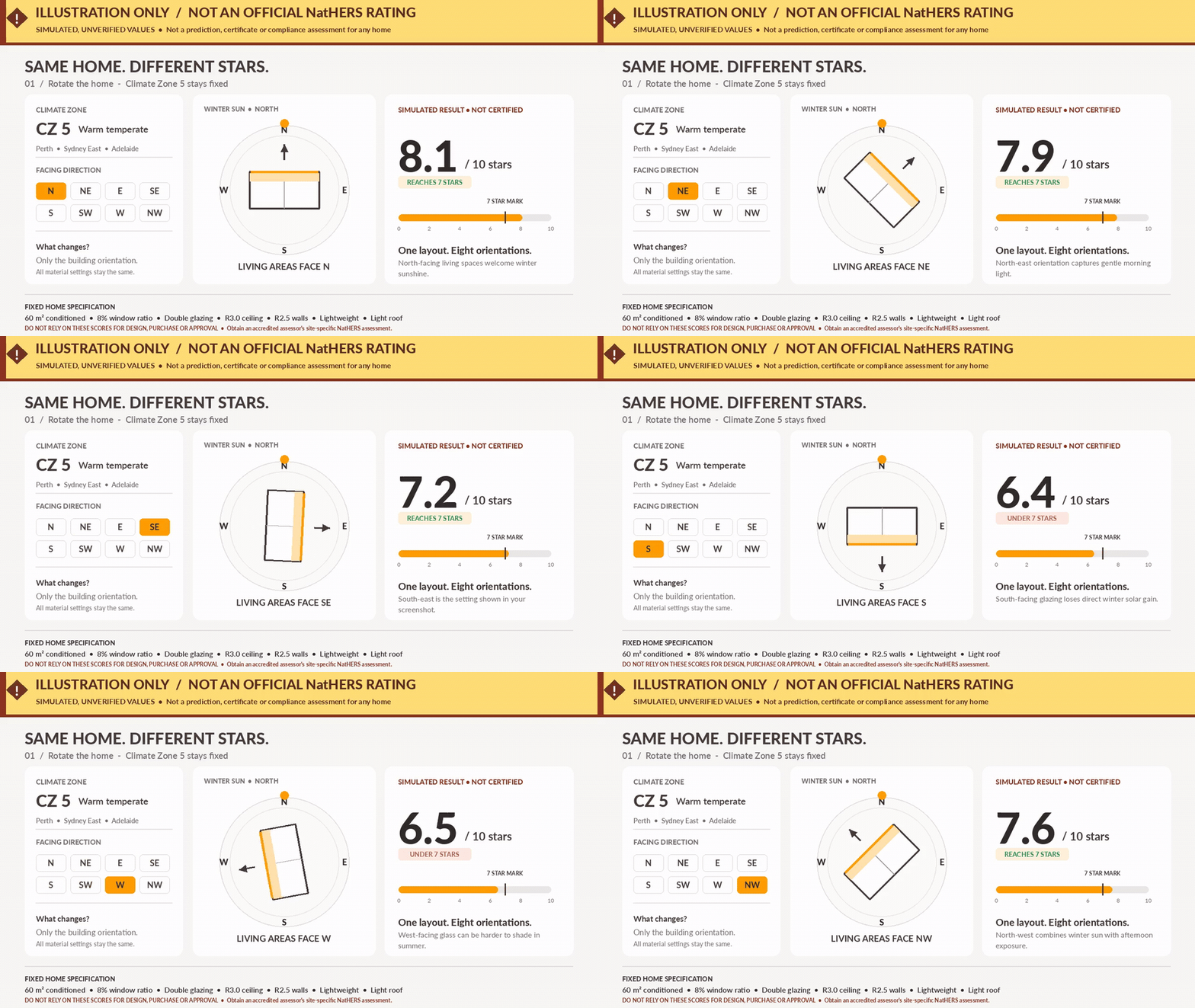
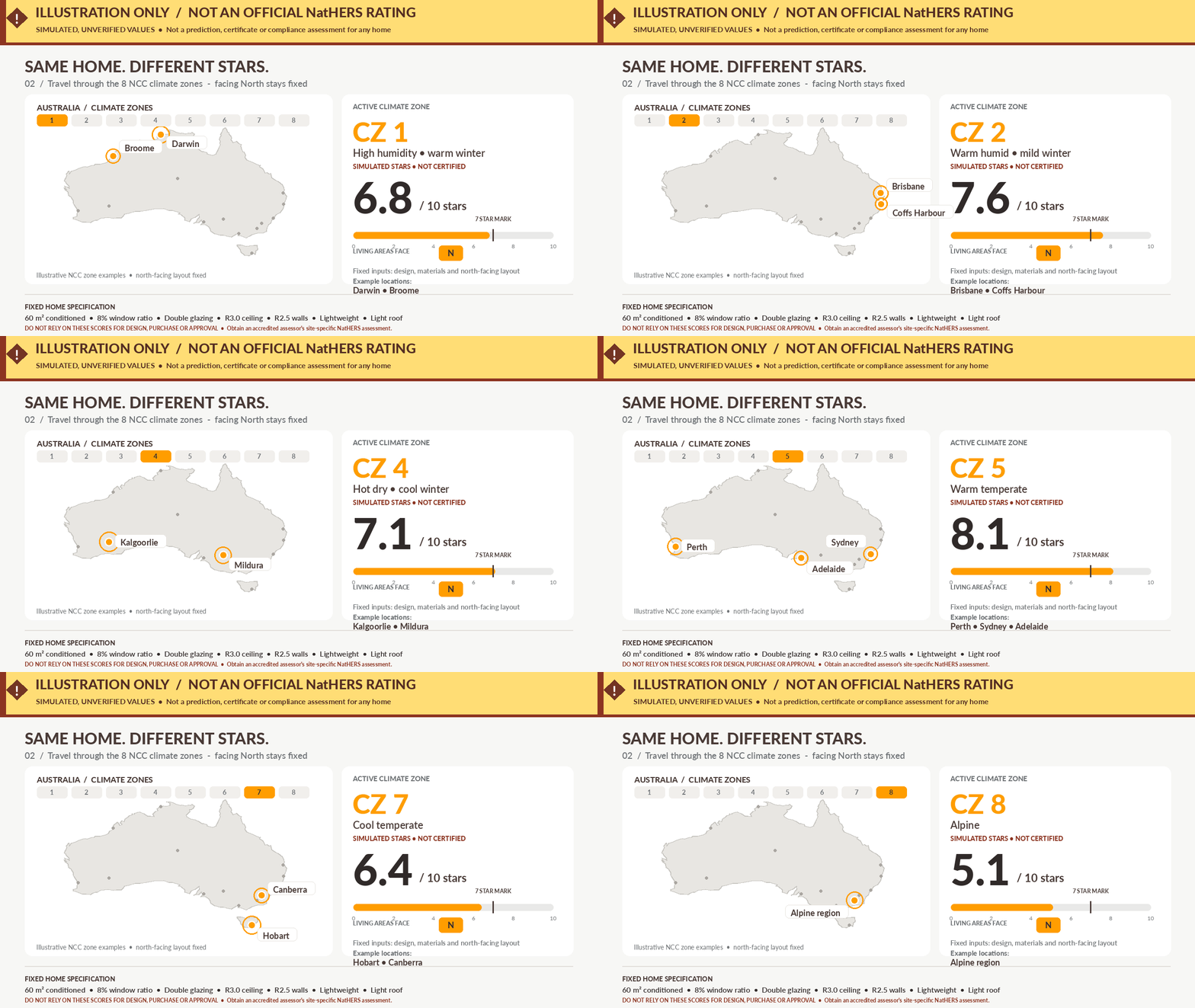
A NatHERS rating, including whether a home reaches 7 stars, belongs to a house on a particular block, not to a floor plan. Keep the design and specification fixed, then change only the direction it faces or the NatHERS climate zone it's built in, and watch the rating move.
Illustration only. This simulator uses a simplified heuristic to show how ratings behave. It is not NatHERS-accredited software and its figures are not a rating for any home. Minimum star requirements differ between states; see the state guide and full disclaimer below.
Run the demonstration
Rotate the home keeps the climate zone fixed and turns the same design through eight directions. Tour the climate zones keeps the orientation fixed and moves the same design around Australia.
Watch the same home change rating
The same design and specification, first rotated through eight orientations, then moved through the eight NCC climate zones. Only one thing changes each time, and the star result moves with it.
For what applies in your state and how a kit home gets to 7 stars, read Can a kit home meet the 7-star energy rating?
One design, 64 different outcomes
Every cell below is the same home with the same specification you've set above. Only the climate zone (rows) and the direction the living areas face (columns) change.
7 star energy rating requirements by state
Most states and territories now require new homes to reach 7 stars, but not all, and not from the same date. Each one adopts the National Construction Code through its own legislation, so the minimum that applies to a home depends on where it is built and when its building permit was applied for.
Transition from 1 May 2024.
From 1 May 2024.
From October 2024, with some exemptions.
From October 2023.
For permit applications lodged from 1 May 2025. Earlier applications are assessed under the previous rules.
Uses its own BASIX system rather than NatHERS 7 stars. Its thermal targets broadly align with 7 stars from October 2023.
7 stars not adopted. Tasmania reinstated NCC 2022 in 2026 and delayed NCC 2025 until 1 May 2027.
Has not adopted 7 stars and remains on its earlier, lower energy requirements.
Status as at October 2026. Transitional rules, exemptions and local variations apply, and requirements change. Your building surveyor or certifier decides what applies to your approval.
Common questions about 7 star energy ratings
What is a 7 star energy rating?
It is a score on the Nationwide House Energy Rating Scheme (NatHERS), which rates a home's thermal performance from 0 to 10 stars based on how much heating and cooling it is likely to need. A 7 star home needs noticeably less heating and cooling than a 6 star home in the same climate zone. Since NCC 2022, 7 stars is the minimum for new homes in most states and territories.
Is a 7 star energy rating required where I'm building?
In most states, yes. Victoria, Queensland, South Australia, the ACT and Western Australia require 7 stars for new homes, NSW uses its own BASIX targets, and Tasmania and the Northern Territory have not adopted 7 stars. Start dates and transitional rules differ, so your building surveyor or certifier confirms what applies to your approval.
Why can the same design get a different star rating?
A rating is calculated for a specific house on a specific block. The two biggest factors are the NatHERS climate zone, which sets how much heating and cooling the location demands, and orientation, which controls how much useful winter sun and unwanted summer sun the windows receive. Change either and the rating changes, even when the design and materials stay identical.
How many NatHERS climate zones are there?
NatHERS divides Australia into 69 climate zones. This page simplifies them to the 8 National Construction Code climate zones so the effect is easy to see. A formal assessment always uses the exact NatHERS zone for the site.
Can a kit home achieve 7 stars?
Yes. Lightweight construction can reach 7 stars with the right combination of glazing, insulation, window sizes and orientation for the site. What it takes, and what it costs, depends on the climate zone and the block, which is why upgrades are worked out once the site is known.
Does this page give me a NatHERS rating?
No. It is an illustration using a simplified heuristic. A NatHERS rating for a building permit must be produced by an accredited assessor using accredited software and your final plans. See the disclaimer below.
Climate zone
Cold climates need far more heating than mild ones, so the same walls, roof and windows score lower in Hobart or Canberra than in Brisbane. Each zone is also graded against its own benchmark.
Orientation
Living areas and glazing facing north collect winter sun and are easy to shade in summer. Facing south loses that free heat; facing east or west picks up hard, low-angle summer sun.
What it costs to close the gap
A home that misses the target on one block may need better glazing, more insulation or less glass to reach it. The upgrade differs from site to site, which is why it can only be priced after the site is assessed.
Does 7 stars apply?
Not everywhere. The 7-star line in this illustration is a reference point, not a rule for your home. Check the state guide above, and confirm with your building surveyor or certifier.
Disclaimer
- This page is a simplified visual illustration provided for general education. It is a heuristic only and is not a substitute for a NatHERS assessment using accredited software such as AccuRate, FirstRate5, BERS Pro or Hero.
- The figures are not calibrated against NatHERS certificates and are not a rating, estimate or prediction for any particular home, design or site. Real results depend on factors this page does not model, including exact window sizes and placement, shading and eaves, floor construction, air leakage, thermal bridging, overshadowing and the specific NatHERS climate zone (there are 69; this page simplifies to the 8 NCC climate zones).
- Do not rely on this page for design, purchasing, compliance or approval decisions. A certified rating can only be produced by an accredited assessor using your final plans and your site.
- Whether a minimum star rating applies, and what it is, depends on your state or territory, its transition arrangements and your approval. Your building surveyor or certifier makes that determination.
- iBuild Building Solutions is a kit home supplier and does not provide energy assessments through this page.